Planetary Systems & Climate Science
EVEN 2909: Introduction to Global Sustainability — Week 4
University of Colorado Boulder — Fall 2026
Planetary Boundaries
The scientific framework for Earth's safe operating space.
The 9 Planetary Boundaries
In 2009, Johan Rockström and colleagues at the Stockholm Resilience Centre identified nine Earth-system processes with thresholds that, if crossed, could trigger abrupt or irreversible environmental change.
Rockström et al. (2009), Nature; Richardson et al. (2023), Science Advances; Planetary Health Check 2025 (Potsdam Institute for Climate Impact Research), which moved ocean acidification across its boundary. Seven of nine are now crossed.
Nine Boundaries, Seven Crossed
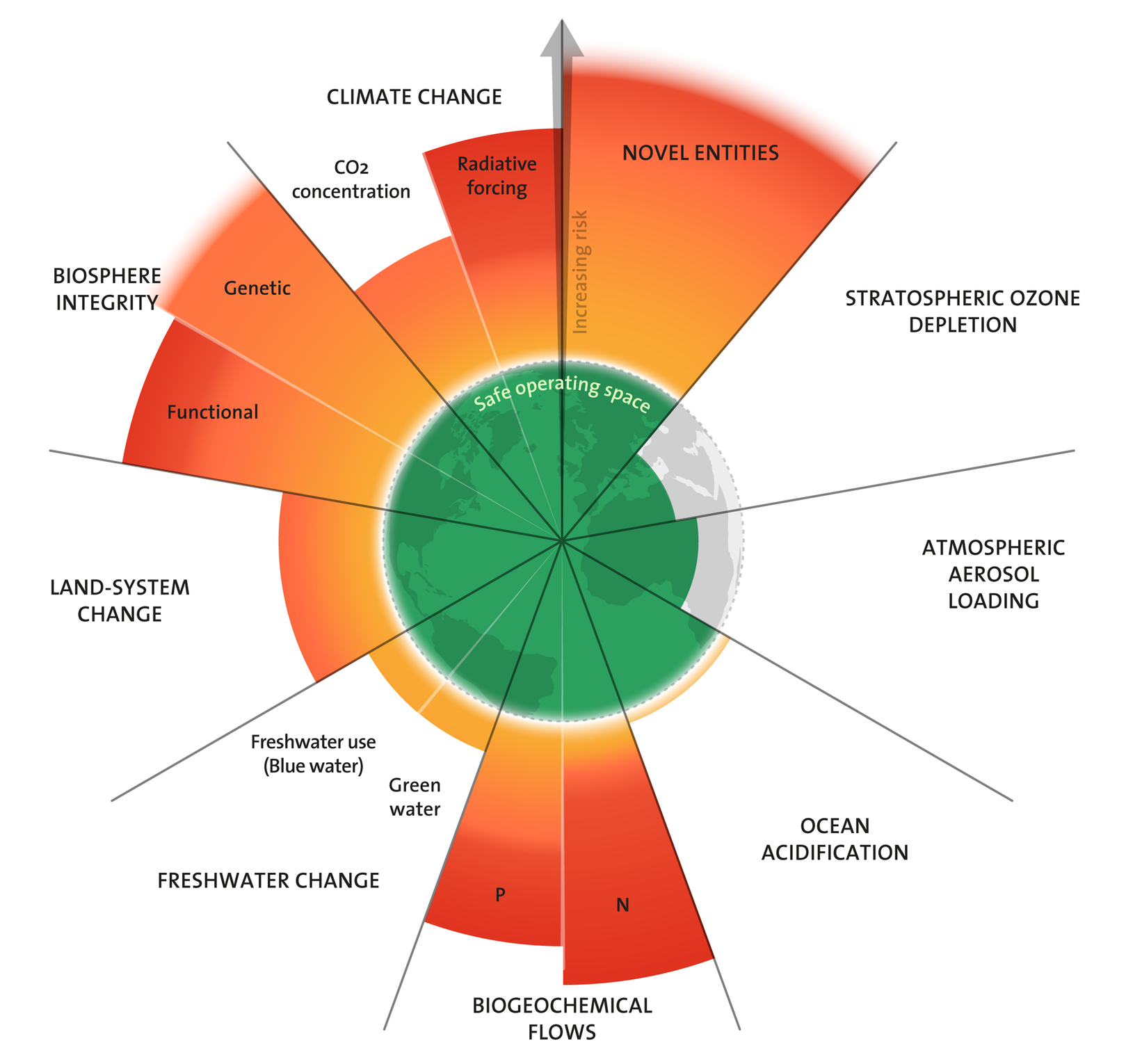
Each wedge is one Earth-system process. The green disc at the center is the safe operating space and the dotted ring is the boundary itself. How far a wedge reaches past that ring is how far we have already pushed the process.
- Green: still inside the boundary. Only stratospheric ozone depletion and atmospheric aerosol loading are here, and both are improving.
- Orange: the zone of increasing risk. The boundary has been crossed and the chance of destabilizing the process rises with distance from the ring.
- Red: the high-risk zone, where severe and potentially irreversible change to a life-support process becomes likely.
Nine processes are tracked with 13 measured control variables, because climate change, biosphere integrity, freshwater change and biogeochemical flows each need two. Every one of the seven crossed boundaries is still trending in the wrong direction.
Figure: Azote for Stockholm Resilience Centre (CC BY-NC-ND 3.0), based on Richardson et al. (2023), Science Advances, and Planetary Health Check 2025.
What the Boundaries Actually Measure
Each boundary is a number on a measurable control variable, marking the edge of the safe operating space for that process.
| Process | Control variable | Boundary | 2025 value | Status |
|---|---|---|---|---|
| Climate change | Atmospheric CO2; radiative forcing | 350 ppm; +1 W/m2 | 423 ppm; +2.97 W/m2 | Crossed |
| Biosphere integrity | Extinction rate; human appropriation of net primary production | 10 E/MSY; 10% | 100–1,000 E/MSY; 30% | Crossed |
| Land-system change | Forest cover remaining, as a fraction of original | 75% | 59% | Crossed |
| Freshwater change | Land area with blue-water (streamflow); green-water (soil moisture) deviations | 12.9%; 12.4% | 22.6%; 22.0% | Crossed |
| Biogeochemical flows | Mined phosphorus applied to cropland; nitrogen fixed for agriculture | 6.2; 62 Tg/yr | 18.2; 165 Tg/yr | Crossed |
| Novel entities | Synthetic chemicals released without adequate safety testing | 0% | Not yet quantified; judged transgressed | Crossed |
| Ocean acidification | Mean surface aragonite saturation (Ω) | 2.86 | 2.84 | Crossed in 2025 |
| Atmospheric aerosols | Interhemispheric difference in aerosol optical depth | 0.10 | 0.063 | Within |
| Ozone depletion | Global stratospheric O3 column | 277 DU | 285.7 DU | Within |
Values from Planetary Health Check 2025 (PIK), DOI 10.48485/pik.2025.017. For ocean acidification and ozone the safe side lies above the boundary value; for the other seven it lies below. Ocean acidification sits 0.02 below its boundary, which is what tipped it over in the 2025 assessment.
The Safe Operating Space
Earth has operated in a remarkably stable state for the past 10,000 years (the Holocene). Human civilization — agriculture, cities, industry — developed entirely within this stable window.
Key concept: The planetary boundaries define a "safe operating space for humanity." Staying within these boundaries does not guarantee safety, but crossing them significantly increases the risk of large-scale, irreversible environmental change.
Why It Matters
- These boundaries are interconnected — crossing one increases pressure on others
- Biodiversity loss weakens ecosystem resilience to climate change
- Nitrogen pollution degrades water systems and accelerates ocean dead zones
- Novel entities (plastics, PFAS, synthetic chemicals) have unpredictable cascading effects
Why Engineers Need to Understand Earth Systems
Engineering Shapes the Planet
- Infrastructure lasts 30–100 years — decisions made today lock in impacts for decades
- Engineers design the energy, water, food, and transportation systems that drive boundary crossings
- 75% of global GHG emissions come from engineered systems
Systems Thinking Is Essential
- Solving one problem (e.g., energy) can worsen another (e.g., land use, water)
- Biofuels reduce fossil fuel use but can accelerate deforestation
- Desalination solves water scarcity but is energy-intensive
- Engineers must design within planetary boundaries, not just optimize individual metrics
"We are the first generation to know we are destroying the world, and the last that can do anything about it." — Tanya Steele, WWF-UK
Climate Science Fundamentals
The physics of the greenhouse effect, the carbon cycle, and the observational record.
The Greenhouse Effect
The greenhouse effect is fundamental physics, not a theory — it was first described by Joseph Fourier in 1824 and quantified by Svante Arrhenius in 1896.
How It Works
- Incoming solar radiation — the Sun emits shortwave radiation (visible light). About 340 W/m2 reaches Earth on average.
- Earth absorbs & re-emits — the surface absorbs ~240 W/m2 and re-radiates it as longwave infrared radiation.
- GHGs trap heat — greenhouse gases in the atmosphere absorb outgoing infrared and re-emit it in all directions, warming the surface.
- Energy balance — without the greenhouse effect, Earth's average temperature would be –18°C instead of +15°C.
The Problem
The natural greenhouse effect keeps Earth habitable. The problem is that human activities are enhancing it by adding more GHGs to the atmosphere, trapping more heat than natural systems can balance.
Energy imbalance: Earth absorbs 1.04 W/m2 more energy than it radiates, averaged over 2006–2025, and that imbalance has more than doubled since the 1976–1995 average of 0.40 W/m2. Spread over the planet’s 5.1 × 10¹⁴ m2 it comes to about 530 terawatts of excess heat, or roughly 8 Hiroshima-sized bombs per second. Source: Indicators of Global Climate Change 2025 (Forster et al., Earth System Science Data).
Key Greenhouse Gases
Not all greenhouse gases are equal. They differ in concentration, warming potential, and atmospheric lifetime.
| Gas | GWP (100-yr) | Atmospheric Lifetime | Primary Sources |
|---|---|---|---|
| CO2 (Carbon Dioxide) | 1 (reference) | 300–1,000 years | Fossil fuels, deforestation, cement |
| CH4 (Methane) | ~30 | ~12 years | Livestock, rice paddies, natural gas, landfills |
| N2O (Nitrous Oxide) | 273 | ~120 years | Fertilizers, industrial processes, combustion |
| F-gases (HFCs, PFCs, SF6) | 1,000–23,000 | Up to 50,000 years | Refrigeration, air conditioning, industry |
GWP = Global Warming Potential. Methane is 80x more potent than CO2 over 20 years, but CO2 dominates total warming because of its sheer volume (~426 ppm) and persistence in the atmosphere.
The Carbon Cycle
Natural Fluxes
- Oceans absorb and release ~90 Gt C/year
- Terrestrial biosphere exchanges ~120 Gt C/year through photosynthesis and respiration
- These fluxes were roughly in balance for thousands of years
Human Perturbation
- Fossil fuels and cement add ~10.4 Gt C/year (38.1 Gt CO2), a record high in 2025
- Land-use change (deforestation) adds ~1.1 Gt C/year (4.1 Gt CO2)
- Total human emissions: ~11.5 Gt C/year (42.2 Gt CO2)
Where Does It Go?
- ~49% stays in the atmosphere (the airborne fraction)
- ~29% is absorbed by the ocean, 11.8 Gt CO2/year, which is what drives acidification
- ~21% is absorbed by land ecosystems, 8.7 Gt CO2/year
The sink problem: Natural carbon sinks (oceans and forests) absorb about half our emissions, but they are weakening as temperatures rise. Over the past decade they took up roughly 15% less than they would have without climate impacts, which feeds back into faster warming.
Emissions and sink partitioning: Global Carbon Budget 2025 (Friedlingstein et al., Earth System Science Data). Decadal averages for the sinks, 2025 projections for emissions.
The Keeling Curve
Charles David Keeling began measuring atmospheric CO2 at Mauna Loa Observatory in 1958. His continuous record is one of the most important datasets in climate science.
The sawtooth pattern reflects seasonal cycles: Northern Hemisphere forests absorb CO2 in summer and release it in winter. The relentless upward trend is human emissions.
The Temperature Record
Global average surface temperature has risen by approximately 1.3°C since pre-industrial times (1850–1900 baseline). 2015–2024 were the ten warmest years on record, and 2024 was the warmest single year at 1.55°C.
Data: WMO State of the Global Climate 2024; NASA GISS, NOAA, HadCRUT5. Current-policies projection: UN Environment Programme, Limiting Overshoot (2026).
Climate Impacts
What 1.3°C of warming is already doing — and what's coming.
Sea Level Rise
Two Mechanisms
- Thermal expansion — warmer water takes up more volume. This accounts for about 40% of observed sea level rise.
- Ice sheet & glacier melt — Greenland and Antarctic ice sheets are losing mass at accelerating rates. Mountain glaciers worldwide are retreating.
Current Rate
- Sea level has risen ~21 cm (8.3 in) since 1900
- Current rate: ~4.5 mm/year and accelerating
- Projections: 0.3–1.0 m by 2100 depending on emissions
Who's at Risk?
- ~1 billion people live in low-elevation coastal zones
- Small island developing states face existential threat
- Major cities at risk: Miami, Jakarta, Mumbai, Shanghai, Lagos
- Even 0.5 m of rise dramatically worsens storm surge flooding
Committed warming: Even if we stopped all emissions today, sea levels would continue rising for centuries due to thermal lag in the ocean and slow ice sheet dynamics.
Extreme Weather
Climate change does not simply make things "warmer" — it loads the dice for extreme events, making them more frequent, intense, and costly.
Heat Waves
Heat waves that once occurred every 50 years now happen roughly every 10 years. At 2°C warming, they will occur every 5 years. Heat is the deadliest weather hazard globally.
Hurricanes & Tropical Cyclones
Warmer sea surface temperatures fuel stronger storms. Category 4–5 hurricanes have become more frequent since the 1980s. Rapid intensification events are increasing.
Drought
Higher temperatures increase evapotranspiration, drying soils faster. The American West is experiencing its driest period in 1,200 years (a "megadrought").
Flooding
A warmer atmosphere holds ~7% more moisture per 1°C of warming (Clausius-Clapeyron relation). This intensifies rainfall events even as droughts worsen between storms.
Climate Tipping Points
Tipping points are thresholds where small additional warming triggers large, self-reinforcing, and potentially irreversible changes. Several may be triggered between 1.5–2°C.
West Antarctic Ice Sheet Collapse
Marine-based ice sheet vulnerable to warm ocean water intrusion. Could commit us to 3+ meters of sea level rise over centuries. May already be underway.
Amazon Rainforest Dieback
Deforestation + drought could push the Amazon past a threshold where it converts from rainforest to savanna, releasing ~90 Gt of stored carbon.
Permafrost Thaw
Arctic permafrost contains ~1,500 Gt of carbon — nearly twice what's in the atmosphere. Thawing releases CO2 and methane, accelerating warming in a feedback loop.
AMOC Shutdown
The Atlantic Meridional Overturning Circulation (Gulf Stream system) is weakening. A collapse would dramatically cool Europe, shift tropical rain belts, and disrupt global weather patterns.
Armstrong McKay et al. (2022), Science. Multiple tipping elements may interact — triggering one could cascade to others ("tipping cascades").
Climate Change in Colorado
Climate change is not a distant, future problem. It is reshaping the state where you live and study right now.
Snowpack Decline
Colorado's snowpack has declined ~20% since 1955. The Colorado River Basin — which supplies water to 40 million people — depends on Rocky Mountain snow. Earlier melt means less water in late summer when demand peaks.
Wildfire
The Marshall Fire (Dec 2021) destroyed 1,000+ homes in Superior and Louisville — 20 minutes from this campus. Fire seasons are now 2–3 months longer than in the 1970s. Colorado's three largest wildfires all occurred in 2020.
Water Supply
The Colorado River Compact (1922) allocated more water than actually flows. Climate change is reducing flows by ~10% per 1°C of warming ("aridification"). Lake Powell and Lake Mead have hit historic lows.
Temperature & Agriculture
Colorado has warmed ~2°F since 1980. Growing seasons are shifting, pest ranges are expanding, and mountain pine beetle outbreaks have killed millions of acres of forest.
The Carbon Budget
How much more can we emit? The math is unforgiving.
The IPCC Carbon Budget
The relationship between cumulative CO2 emissions and global temperature rise is nearly linear. This means we can calculate a finite "budget" of remaining emissions for any temperature target.
What this means: At current emission rates (~42 Gt CO2/year), the remaining carbon budget for limiting warming to 1.5°C runs out before 2030. For 1.7°C the budget is ~525 Gt (about 12 years); for 2°C, ~1,055 Gt — about 25 years at current rates.
Global Carbon Budget 2025 (Friedlingstein et al., Earth System Science Data), 50% likelihood budgets from the start of 2026.
Why This Matters for Engineers
- A power plant built today will operate for 40+ years
- Buildings designed today will stand for 50–100 years
- Transportation infrastructure locks in travel patterns for decades
- Every infrastructure decision is a carbon budget decision
Planning for Overshoot
On 2 September 2026, a week before this lecture, the UN Environment Programme published a 141-page assessment concluding that the 1.5°C target has been missed. The remaining task is to limit how far past it the world goes, and for how long.
Overshoot, Peak, Decline
- Warming passes 1.5°C, keeps climbing, peaks, and is then drawn back down by removing CO2 from the air
- How fast emissions fall sets the height of the peak; how much CO2 is removed sets how fast the curve comes back down
- Temperatures would not return to today’s levels for decades or centuries, and glacier loss and sea level rise are effectively irreversible on that timescale
- Most scientists regard a peak as low as 1.8°C as unlikely
The report’s own verdict on the pathway: “It is simply the best remaining option.”
The Engineering Problem
- Industrial capacity to pull CO2 from the air is currently tiny against what these pathways assume
- Reforestation at the scale discussed would cover areas larger than entire US states, competing with agriculture and exposed to wildfire and heat stress
- Adaptation and resilience now have to be designed for a sustained period above 1.5°C
- Climate Analytics criticized the report for risking a message of apathy and for not calling explicitly for a fossil fuel phase-out
UN Environment Programme, Limiting Overshoot, 2 September 2026, 141 pp. Reporting and expert comment: Chico Harlan, The New York Times, 2 September 2026, with Glen Peters (CICERO) on the land area required for reforestation.
Emissions by Sector
Understanding where emissions come from is essential for knowing where engineers can make the biggest impact.
Breaking Down Energy (73%)
- Electricity & heat production: 30% of total — the single largest sector
- Transportation: 16% — road vehicles, aviation, shipping
- Manufacturing & construction: 12% — steel, cement, chemicals
- Buildings: 6% — direct heating and cooking fuel
- Other energy: 9% — fugitive emissions, oil/gas extraction
Data: Climate Watch / World Resources Institute, based on IPCC methodology.
What Can Engineers Do?
From understanding the problem to designing solutions.
Mitigation vs. Adaptation vs. Resilience
The three pillars of climate response — sustainability engineers need to work across all three.
Mitigation
Reducing emissions. Renewable energy, energy efficiency, electrification, carbon capture. The goal: prevent further warming. This is where most engineering effort should focus.
Adaptation
Adjusting to changes already locked in. Flood barriers, drought-resistant crops, building codes for extreme heat, redesigning stormwater systems. Even in the best scenario, significant adaptation is needed.
Resilience
Building systems that can absorb shocks and recover. Redundant infrastructure, distributed energy systems, nature-based solutions, community preparedness. Designing for surprise.
Critical distinction: Mitigation addresses the cause. Adaptation addresses the symptoms. We need both — but without aggressive mitigation, no amount of adaptation will be sufficient.
The Sustainability Engineer
Design systems that operate within planetary boundaries while meeting human needs.
What This Looks Like in Practice
- Energy systems: Design and deploy solar, wind, storage, and grid infrastructure at scale
- Water systems: Build treatment and distribution systems that are energy-efficient and climate-resilient
- Buildings: Create net-zero buildings through passive design, efficient HVAC, and on-site renewables
- Materials: Develop low-carbon concrete, steel, and plastics; design for circularity
- Carbon markets: Quantify, verify, and trade carbon offsets and credits
- Data & monitoring: Deploy sensors and analytics to track environmental performance
Preview: Course Topics Ahead
- Weeks 5–6: EnRoads climate simulation & the Star Power game
- Week 7: Monitoring, evaluation & data
- Weeks 8–9: Water infrastructure & treatment
- Weeks 10–11: Food systems & the circular economy
- Weeks 12–14: Buildings, transport, carbon markets & energy systems
- Week 15: Environmental justice
"What is the single most impactful engineering intervention for climate change — and why?"
Consider these dimensions:
- Scale: How many gigatons of CO2 could this intervention avoid?
- Speed: How quickly can it be deployed?
- Cost: Is it economically viable at scale?
- Feasibility: Does the technology exist, or does it require breakthroughs?
- Co-benefits: Does it improve health, equity, or other outcomes?
There is no single right answer — but some interventions are dramatically more impactful than others. Be ready to defend your choice with evidence.